The Night I Realized My Alarm Was Ruining My Life
February 12, 2019. The bathroom floor in our Boulder rental. Cold tile against my back, the faucet dripping in G sharp, and Leo screaming from the next room. My phone glowed 3:47 AM. I was doing math I shouldn't have been doing at that hour.
If I fall asleep now, that's two hours and thirteen minutes before the next feeding. If I skip the feeding and let my husband handle it, I still have to pump later. Twenty minutes lost. Net gain: maybe ninety minutes of actual rest. Maybe.
I have a PhD in behavioral neuroscience. I spent six years at CU Boulder studying circadian rhythms. I presented at Sleep 2015 in Seattle. And there I was, a grown woman on a bathroom floor at four in the morning, calculating sleep intervals like a desperate gambler counting cards.
Sleep deprivation doesn't announce itself. It creeps. It steals your vocabulary first — you start saying "thing" and "stuff" instead of actual nouns. Then it takes your sense of humor. Then your patience. Then, one Tuesday in February, you try to put the milk carton in the laundry hamper and stand there for thirty seconds wondering why it doesn't fit.
That was my life. But I told everyone I was fine. Fine is the lie tired people tell themselves because admitting you're broken feels like failure.
My alarm went off at 6:15 AM every morning. I picked 6:15 because it gave me exactly forty-seven minutes to shower, dress, feed Leo, and get him to daycare before my first client call at 7:30. Forty-seven minutes is not enough time for any of those things. I knew this. I did it anyway.
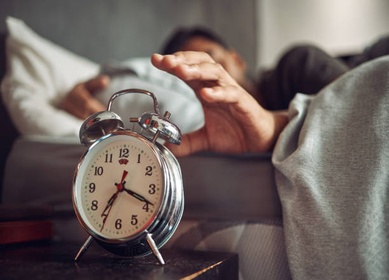
I used four alarms. Sometimes five. 6:15. 6:22. 6:30. 6:37. My husband's alarm at 6:45 served as my emergency backup — the "oh no" alarm.
What actually happened most mornings looked nothing like a plan. At 6:15, I'd swipe the phone off without opening my eyes. No memory of this. Ever. At 6:22, I'd groan and pull the pillow over my head. At 6:30, I'd sometimes sit up, check the time, see that I had "plenty of time" (I absolutely did not), and lie back down. By 6:37, my husband would poke me. "Sarah. You're going to be late." At 6:45, I'd finally drag myself vertical, dizzy and furious, stumbling toward Leo's room where he'd been awake since 6:15 anyway, talking to his stuffed octopus.
By 7:10, I was speed-walking to daycare in pajama pants under a coat. By 7:30, I was on Zoom pretending I hadn't just had a breakdown in the kitchen. I did this for eighteen months. Eighteen months of pretending that five fragmented hours was enough.
The night everything cracked open was February 12. Leo had been sick for three days — some daycare plague, probably RSV, maybe just a vicious cold. He woke every forty-five minutes coughing. My husband and I took shifts, but by night three, both of us were useless. Around 2 AM, I fed Leo, rocked him back to sleep, and then couldn't fall asleep myself. I lay there for an hour, listening to my husband breathe, watching the baby monitor climb: 2:15, 2:30, 2:47, 3:00.
At 3:15, I gave up. Bathroom floor. Phone in hand. And I realized something that made me want to throw the phone at the wall.
I wasn't tired because Leo was a bad sleeper. I wasn't tired because new moms are supposed to be tired. I was tired because I was doing everything wrong, and I knew better.
If I went to bed at 11 PM and my first alarm hit at 6:15, that was seven hours and fifteen minutes in bed. But I wasn't sleeping seven hours. I was waking up two to four times with Leo. Then I was hitting snooze four times every morning. My actual sleep? Maybe five hours. On a good night, six. And I was a sleep scientist. The irony tasted like bile.
I started tracking. February 1 through February 11. Apple Watch plus a paper log — because I don't trust the watch alone, but I don't trust my memory either.
Average time in bed: 7 hours 12 minutes. Average actual sleep: 4 hours 47 minutes. Average night wakings: 3.4. Average snooze presses: 3.7. Average "feeling like garbage" rating: 9.2 out of 10.
Four hours and forty-seven minutes. That's not sleep deprivation. That's sleep torture. And the snoozing? Every time you fall back asleep for nine minutes, you start a new sleep cycle. Nine minutes isn't enough to complete anything. You're waking up in the middle of REM or deep sleep, over and over, like someone repeatedly slamming a door on your brain.
I had written a blog post two years earlier called "The Snooze Button Is a Trap." I gave a talk at a sleep conference with that exact title. And there I was, hitting snooze four times a day like some kind of sleep impostor.
Anger doesn't fix anything. A plan does. So I made three changes. Not overnight — nothing in sleep happens overnight except sleep itself. But within two weeks, my mornings felt different. Not perfect. Different.
First, I stopped using a fixed morning alarm. Instead, I figured out my natural cycle length — about eighty-five minutes, slightly shorter than the textbook ninety — and set my alarm for the end of a cycle, not the middle. If I went to bed at 10:30 PM, my cycles ended around midnight, 1:25 AM, 2:50 AM, 4:15 AM, 5:40 AM, and 7:05 AM. So I set my alarm for 7:05 instead of 6:45. Twenty minutes later, but I woke up between cycles. The difference was staggering. No grogginess. No snooze. I just opened my eyes.
Second, I stopped pretending I could function on five hours. This sounds obvious, but the sleep-deprived brain is terrible at judging its own deprivation. There's a classic study — people who slept five hours a night for two weeks reported feeling "fine" but performed as badly as people who hadn't slept in forty-eight hours. I was those people. I said "I'm fine" while forgetting to put on pants before a Zoom call. That happened. February 2019. I will deny it if asked.
So I made a rule: no work after 9 PM. Emails wait. Dishes wait. Leo's laundry waits. My sleep doesn't.
Third, I actually used my own sleep quality calculator. I built this thing — a ten-question quiz that scores your sleep from 0 to 100 — and I had never taken it myself. On February 13, at 7:08 AM, after waking up without snoozing for the first time in months, I took it. My score: 43 out of 100. That's not just bad. That's "see a doctor" bad.
I took it weekly after that. 43. Then 51. Then 62. Then 68. Then 74. It never hit 100. It probably never will — I have a seven-year-old. But 74 feels a hell of a lot better than 43.
The real lesson wasn't about Leo, or my husband, or the house, or the dripping faucet. The problem was me. Not in a self-blame way. In a "you're the only one who can change your behavior" way. I was choosing to stay up late answering emails. I was choosing to treat my alarm like a suggestion. I was choosing to believe "I'll sleep when I'm dead" was a personality trait instead of a warning sign.
If you wake up feeling terrible every day, don't accept it. Check your alarm. Check your bedtime. Check your snooze habit. And for the love of everything, stop pretending you're fine when you're not.
It's 2026 now. Leo is seven. He still wakes up sometimes — nightmares, thirst, the usual kid chaos. But I'm not on the bathroom floor at 3:47 AM anymore. I wake up at 6:30 most days without an alarm. My body just does it. I drink coffee while Leo eats his waffle. I walk him to school. I start work at 8:00 AM without wanting to cry.
I still have dark circles. I still get tired. I'm not a wellness influencer. I don't do ice baths or blue-light glasses or any of that nonsense. But I'm not suffering anymore. And that's enough.
P.S. Two weeks after I fixed my alarm, my husband asked if I'd gotten a new face. I told him it was sleep. He didn't believe me. Then he tried the cycle calculator. Now he wakes up before I do. Annoying, honestly.
