Reading Your Sleep Debt: When to Catch Up and When to Let It Go
"I'll sleep when I'm dead." — a text from my brother, 11 PM, last Tuesday.
I didn't respond. I was too tired to argue.
But he's not wrong about one thing: you can't sleep your way out of a busy life. You can only prioritize. And sometimes that means accepting a certain amount of sleep debt, managing it, and moving on.
I used to think sleep debt was like credit card debt — you should pay it off as fast as possible, zero balance, end of story. Then I had a kid. Then I had a book deadline. Then I had both at the same time. And I realized that some debt is unavoidable. The question isn't "how do I have zero debt?" The question is "how much debt is too much, and what do I do when I'm in it?"
Let's start with what the research actually says. A study from the University of Pennsylvania, around 2018, kept people on five hours of sleep for two weeks. The subjects said they felt "fine" after a few days. But their reaction times were as bad as someone who hadn't slept in forty-eight hours. So your brain lies to you. You can't trust how you feel.
That's why you need a number. Not an obsession. Just a number.
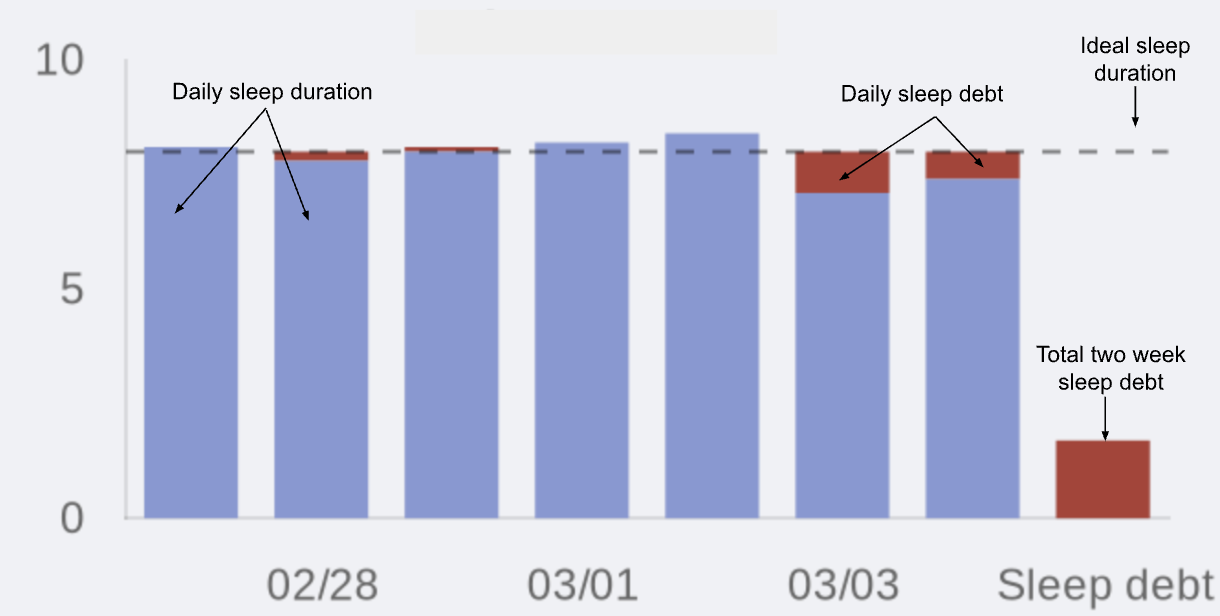
The sleep debt tracker gives you that number. It's simple: target sleep minus actual sleep, added up over a week.
Plug in your numbers for a week. Don't cheat. If you slept five hours when you needed seven and a half, that's two and a half hours of debt. Multiply by seven days. That's your weekly debt.
A guy I worked with — let's call him Dan — did this and got a weekly debt of twenty-one hours. Twenty-one. He said "that can't be right." I asked him to double-check his log. He had been sleeping four to five hours a night for months. It was right. He didn't believe me until he fell asleep at his desk during a Zoom call. His boss saw him. That was his wake-up call.
So how much debt is too much? Anything over ten hours a week starts to impair your driving, your mood, your immune system. Over fifteen hours? You're in the danger zone — increased risk of accidents, depression, heart problems. Over twenty hours? See a doctor. Something else might be going on.
But here's the nuance. Not all debt is equal. Debt from fragmented sleep — waking up five times a night — is worse than debt from slightly short sleep. Debt from a single bad night is easier to repay than debt from chronic deprivation. And debt accumulated while you're sick or stressed hits harder.
So you need to know not just how much debt, but what kind.
That's where the sleep quality score comes in. If your debt is high but your quality score is also high — say, above seventy — you might just need a few extra hours. If your debt is high and your quality score is low — below fifty — you have a bigger problem. You're not just short on sleep — you're getting bad sleep.
I learned this the hard way. After Leo was born, my debt was astronomical — around twenty-five hours a week. But my quality score was also terrible, like thirty-five. I was waking up every hour, so the little sleep I got was garbage. Focusing only on debt would have been useless. I had to fix the fragmentation first — which meant dealing with Leo's sleep, not mine. Once he started sleeping longer stretches, my quality score jumped to sixty, and then I could work on paying down the debt.
So here's a rule of thumb. If your quality score is below fifty, fix that before you worry about debt. Better to sleep six hours of good sleep than eight hours of trash.
Now, assuming your quality is decent, how do you actually pay down debt? Not by sleeping twelve hours on Saturday. That's like binge-eating after a diet. It doesn't work. You'll just feel groggy and throw off your circadian rhythm.
The right way is slow and boring. Add fifteen to twenty minutes to your sleep each night for a week. That's it. If you normally sleep six hours, aim for six and a quarter. Do that for five days. Then add another fifteen minutes. Over a month, you can add an hour. That's seven hours of extra sleep per week — enough to cut a ten-hour debt in half.
But what if you can't add time? Life happens. Deadlines, kids, travel. In that case, focus on naps. A twenty-minute power nap can reduce your subjective sleepiness by about thirty percent, even if it doesn't erase the debt. And a ninety-minute nap on your day off can knock out a chunk of debt without messing up your schedule.
I had a friend — she's a lawyer, works sixty-hour weeks — who used to let her debt pile up to fifteen to twenty hours, then crash for ten hours on Sunday. She felt worse on Monday. I convinced her to try a ninety-minute nap on Saturday instead. She said "that's it?" I said try it. She did. Her Monday morning grogginess dropped by half. Because she stopped confusing her circadian rhythm.
Here's a controversial take. Sometimes you shouldn't pay down debt. If you have a big project due, or a sick kid, or travel — just accept that you'll be tired. Don't stress about the debt. Stress makes the debt worse. Sleep debt is not a moral failure. It's just a physiological state. You can be in debt and still function. You just can't function at one hundred percent.
The key is knowing your personal red line. For me, anything under seven hours of weekly debt is fine. I feel a little tired but I can work, parent, exercise. Between seven and twelve hours, I'm irritable and less productive. Above twelve hours, I start making mistakes — forgetting appointments, leaving the stove on, snapping at my husband. That's my red line.
Find yours. Pay attention to when you start making stupid errors. That's the point where debt is costing you more than sleep.
One more thing. You can't "bank" sleep. I've tried. Sleeping ten hours on Sunday does not protect you from a four-hour night on Tuesday. Your body doesn't work that way. The only thing that helps is consistency. So if you know a bad week is coming — finals, a product launch, a newborn — try to get as much sleep as possible in the weeks before, not the night before. That won't eliminate the debt, but it will raise your baseline so the crash isn't as deep.
I'll leave you with this. Stop checking your debt every morning. That's like stepping on a scale every hour. Check it once a week. If it's high, make a small adjustment. If it's not, ignore it. The goal isn't zero. The goal is good enough.
P.S. My brother texted me again last night: "I slept six hours and I feel fine." I asked him to take a reaction time test online. He scored in the bottom ten percent. He didn't respond.
